Page 10 of the comic I am working on. I had a slow in momentum in making this because I had drawn ahead before finishing the story. I am actually still not finished scripting the remaining pages.
I’m happy with the tone of this page. It’s a quiet pivot point in this short story and I wanted this page to be sparse but also emotional.
The sulking astronaut, migrating geese, and the recurring reference to time passing work well to me.
I’m starting pencils for the sixth page of my comic, The Rocket.
Never having made a comic with as much focus before, I am learning the power of thumbnails for planning visual narrative. I have sketched and made thumbnails for countless design projects over the years and there is a bunch of crossover between that and the sequential art form of comics.
What’s so interesting about the comic page is trying to engage a reader’s head in a balance between written words and visuals. I am trying to learn what to say and what to show.
Because I am writing and drawing, I have the ability to make text and visual edits as I go to suit a specific page’s needs. I have changed the scripting while doing the lettering based on what I have chosen to draw quite a few times. Subtle shifts to tighten language that would suit the phrasing of a novel but bogs down a comic page.
Here’s the first page of the comic I am making with its digitally painted colours. This is the first time I’ve coloured a comic page. As a kid, my friends and I made a few attempts at making comics, some with quite a few pages, but none of them made it to the colouring stage.
I am doing most of this work digitally. Some foundational thumbnails and sketching is being done on paper but the majority of the drawing is with an Apple Pencil on an iPad. This process allows me lots of freedom to mix and match techniques but also comes with technical hurdles like Procreate crashing randomly after a certain number of layers and also simply the oddity of drawing on a slab of glass.
But because of this process, I can also mull over stylistic choices. Now that I have rendered this painterly and fairly saturated take on the first page, I feel like I want to try to recolour the whole thing using a single colour as that might suit the mood better. The first page is a good place for me to make that choice before getting too deep.
So expect to likely see that as the next in-progress image I share. I don’t think I’ll be sharing every single page as I make it but I’m still in an exploratory phase so it makes sense to show that.
This is the first fully inked page of the comic I am working on. It’s called The Rocket and it will be a single issue length story that blends bits and pieces of my childhood with pure fiction.
It’s a daunting project because, as a lover of comics my whole life, there are so many artists I might compare myself to. But I am trying to just do my thing and learn as I go and avoid making any direct comparisons to work that I love.
I’m working on a comic and as usual I am feeling so much respect for the level of attention it takes to make even a single page.
The story is set in 1977 and pulls from a range of experiences in my hometown with elementary school friends but also has some light sci-fi elements.
I’m moving back and forth between sketching on paper and more refined drawing in Procreate.
One of the things I knew already, but can really feel in practice, is how hard it is to keep characters consistently proportioned and featured. Also kid bodies are harder to get right than adult bodies.
We were watching a video of a conversation with British painter Rose Wylie and they were looking at a short series of hers in the style of retablos or ex votos — usually small paintings honouring a saint or showing a moral story.
We have a few wonderful Mexican ex votos painted on tin and part of what I love about them is the tight text at the bottom of each image. That was true of Rose Wylie’s versions as well and it made me wonder about trying something in that format for myself.
Gayla had brought out some cheap dollar store markers we have and I found an old half-used Strathmore grey-paged notebook and made a few drawings quirking pulling text from nearby books.
I don’t want to fully mimick the style of ex votos — although I have seen that done quite well by people like Esther Pearl Watson.
But there is definitely something that feels good to me in this format that I should follow up on in some other form.
The simple act of “activating” a sourdough starter culture is both mundane and alchemical. There is a magic in tending to this basic mix of flour, water, and the myriad invisible yeasts that reside in spaces around us.
And then the power of this seemingly inert goop to spring into action and allow me to turn more flour and water into a loaf of rich soft and crusty bread is a secondary magic.
Since moving here one time of the year I look forward to is when we first start seeing the magical blinking and trailing lights of fireflies. It’s been a mostly cool spring here but with a heat wave coming on and the night feeling heavier and humid I felt like I might see them. So I went into a dark room that looked out on our mostly unlit backyard (neighbours on one side have permanent “security” lights) and yes, firefly season has begun.
Sometimes I buy an old book from a thrift store or junk shop simply for one image inside. In this case, this image is from a 1927 book called, Brock’s Book on Birds, which seems to be one of those advertising in book form that was fairly common in the 1920–30s especially.
This very unique etching is in the chapter “Washing Canaries”. I loved the oddity of the rather awkwardly posed hand and the softly dismayed canary. It’s the sort of image that makes me want to make something without having any idea what.
That happens to me where I see something and a bunch of things tilt in a direction to pull my attention towards an initial curiosity that branches and takes me somewhere very different.
I’m not going to suddenly make art that connects in any recognizable way to having a suitably clean canary but these points of attention are still mental landmarks for me along a creative path.
Juvenile songbirds sing what is called a plastic song which means they are still learning their mature set of calls. I like to think sometimes that the plastic phase is what I hope to stay within in terms of art making and experience in general. I want to stay malleable and flexible while making the occasional “mistake”.
A conversation with a friend got me thinking about the pressure to start something new as an already formed, planned, and polished production. I prefer when things are raw and forming somewhat in real time.
I think it’s good for things to be rough around the edges but these days it feels like these are a lot of “brands” that feel like pretty wrapping around an empty box.
I’d rather have an unwrapped gift handed to me by someone.
I made drawing 34 in the Red Book live on video tonight. It was an experiment in the format and to get a sense for whether I would want to try it again. I’ll do a few more tests at least.
More thermal printing adventures. The phone to printer to copier flow makes for some great ways to take previous artwork and also bits and pieces of my home environment and change their context.
I gang up the small thermal prints on a quarter Letter page and then copy them at 100 and 200%. And then sometimes another 200% for good patches of texture.
I also use any extra space on the paper to do quick mark making so that can also be copied/enlarged.
I have been picking away at this one over a few short sessions — while making coffee. The black structured forms follow the mostly hidden text that was on the page. I think I’ll be pulling some of the enlarged thermal print images into this so I am curious to see how that feels.
I also bought another book from the thrift store that will become some form of project book like this. More on that soon.
We collected this water, soil, and plant material from two vernal pools that regularly form where we live. It is amazing to get this view into the under-the-surface activity of these ephemeral ponds. There are fairy shrimp, daphnia, worms, what look like gastropods, more that we can’t identify, and likely so much more at the microscopic level.
This is exactly why I was interested in thermal prints. There’s a whole complex world of marks and matrices as I enlarge and then enlarge again (and again!).
Made some 200% enlarged copies of the thermal prints. Fun to make secondary drawings on the copied versions. I’ll try also making some 400% copies next just to really zoom in on the pure texture and move passed the frame of the original drawings.
We recently bought a few low cost and low quality ways to make thermal prints. It was an idea my partner Gayla and I both had for some time without either of us acting upon it. We both wanted a form of low committal analogue output to use in a variety of not fully discovered art projects.
Both of us had been nudged back into thinking and action by recently seeing other artists incorporate thermal printing into their work. Gayla sourced a few different toy camera and printer options in the $20–40 range and placed some orders.
Not knowing exactly what the outcome or the plan is, tracks with much of both of our art processes over the years. We each like to explore and discover how and what we make by learning and doing.
For me, the first thing I was drawn to was the coarse dithered black only rendering of the thermal images. Some of the thermal print options will output more tonal “greyscale” images but I really prefer the prints that are crappier and even a bit harsh in their dithering process.
I wondered about blowing up the textures of the prints for a variety of images and using them as collage materials. And I likely will do that. But the first thing that has piqued my interest is printing out images of my Red Book drawings. I am printing to a ~$20 thermal printer that uses a 57mm-wide roll of paper. This is the exact same kind of paper store receipts get printed to. There is nothing precious and certainly not archival about this as a material and that is much of the point.
These tiny images and the way they strip and condense the details of my drawings are interesting to me. I don’t think of them as a way to actually reproduce my drawings but more as a lateral way of using that work to make something connected but new.
I don’t know what that will be yet and that’s the exciting part.
This one is thick with paper and paint layers. At one point the yellow and orange paint was very dominant as it has been in previous drawings but I wanted to try pushing that back and so I brushed on and then scraped away some white gesso. It made things extra patchy and messy but it mostly did what I wanted by subduing some aspects and letting other parts come forward.
I think that complexity and simplicity, chaos and stillness can reside together much of the time. Lately I have been thinking about the density and complexity of trees. As living presences, trees might be thought of a pure and simple, a respite from manufactured stressful complexity. But they aren’t all that simple and are embodiments of visual layers upon layers can be seen as a whole.
Visual art can be like that too. Marks placed upon other marks, paper pasted sheet upon sheet, paint mixing and thickening. The visual results aren’t always simple but there is still a singular nature to a work of art no matter how layered and complex it might be.
…
This was written as a comment on this post by Manuela Thames.
This mini orchard does exist. We have a row of three mature pear trees and an even older apple growing in the land where we live. But this sketch of the three pears is imagined in that I didn’t look at a reference or go out there and draw them from sight. I do want to try some plain air drawing out there this year though — something I’m not familiar with at all.
I added a few leaves to these imagined versions of our pears but they don’t actually even have leaf buds at this time of the year.
What is represented somewhat accurately is the spacing between the trees and which currently have other companion plants growing underneath them. There is also a small patch of raspberries between two of the trees.
I was looking for something else in my insane camera roll and came across photos and a short video of this Land/Body piece from 2017. It was one of three that I made in this circular landscape format with these rough nervous system figures attached.
It was a rare case where I submitted the three pieces to a show and two of them actually sold. I hadn’t documented all three so I now only have some vague memories of what they all looked like finished and some in-progress shots.
Each had a different imagined landscape painting and unique carved balsa figure.
Finding this again made me realize that I want to play with this kind of dimension again. I loved the shadow play in this case especially as the video shows.
This is a pine tree sketched from memories of recently seen pine trees. Trees are so difficult to represent because they take up space and have a type of visual density that can be hard to articulate.
I don’t mind this little sketch but it does feel more like a drawing of a scale model of a tree? I intentionally tried to place some of the imagined branches moving away from the front of the view but it still reads a bit flat like the tree only has one side.
Nature is wonderful and hard to capture which is also a wonderful thing.
Something I wrote in an email thread with other artists/makers…
My sense of websites, having had lots over the years that I started, finished, redesigned, endlessly tweaked, and deleted, is that they are never done and that is what can make them great.
The “finished” or “ready” website is often too late to do what we want it to do. It can feel immediately static or out of sync with where we are. Websites are, by nature, fluid and changeable things and so it can be wonderful to just let them do that and connect us with where we are.
I think the harder question is whether to narrow the focus of a website to display one version of ourselves. I have struggled with that. My current website is me in the various states that my creative practice takes but doesn’t really touch much on what I have done to make money over the last 30+ years as a designer and only lightly touches on the years in which photography was my primary art form.
We spilt ourselves into these versions of identity.
A small sketch as I lay in bed with my leg elevated after knee surgery yesterday. This view has similarities to the woods at the back of the land we live on. The branches and forms made from quick scratchy pencil marks are imagined and don’t actually reference the true natural makeup of that space.
Despite mostly making abstract artwork, when I actually set out to “sketch”, natural forms are usually what comes out. This is also the kind of mark making I give myself the most trouble with. As soon as a drawing attempts to represent something real, my inner critic rises up to full height.
Something intended to convey an impression of a space always falls short to me. Possibly because the set of impressions natural spaces can make on us are so deep and multifaceted that I ask too much of my pencil marks.
The other day, multidisciplinary artist Wade Johnston posted about a postcard project he was starting up for fun. I jumped at the chance to receive something human in my mailbox and even better a handmade piece of mail art.
And it was all I hoped for. Wade’s postcard has one of his artworks affixed to the front and then the back also has a print from his thrifted Kodak Memo Shot thermal printer/camera.
I have been curious about getting a little thermal printer for collage work so it was an extra bonus to have that as part of this artwork.
I was both looking forward to drawing on this page and also had a certain level of anxiety.
The photo at the top of Jesse Owens in mid jump is such a powerful image to react to that I knew I would want it to stay the focus of this drawing. That comes with anxiety because I don’t normally have anything preconceived or assumed before I start drawing.
Not that I knew at all what I would do ahead of time but just simply that one aspect of the existing page was more important to me than normal.
I shared a number of my recent drawings with some friends and it was a nice reminder to keep how and when I share what I do a wide circle. For me at least, I do better at being kind to myself and making more things that feel good to me when I share aspects of that making and the feelings that come with it.
Aim is True
One artist friend asked…
“Are you just going with the flow when you work on these? Letting your hands make the decisions instead of your brain, like a creative game of Ouija board?”
To which I replied…
“Very much so. It’s just reacting to what’s on the page to start and then I just follow myself as I make marks and add collaged elements. I’m not a planner when it comes to making art. I prefer intuitive flows for sure.”
It’s not something new that I haven’t said about how I make art before. But it reminded me that I enjoy the whys and hows of other people’s making and that revealing myself is often the way to find out more about others.
Just Fall
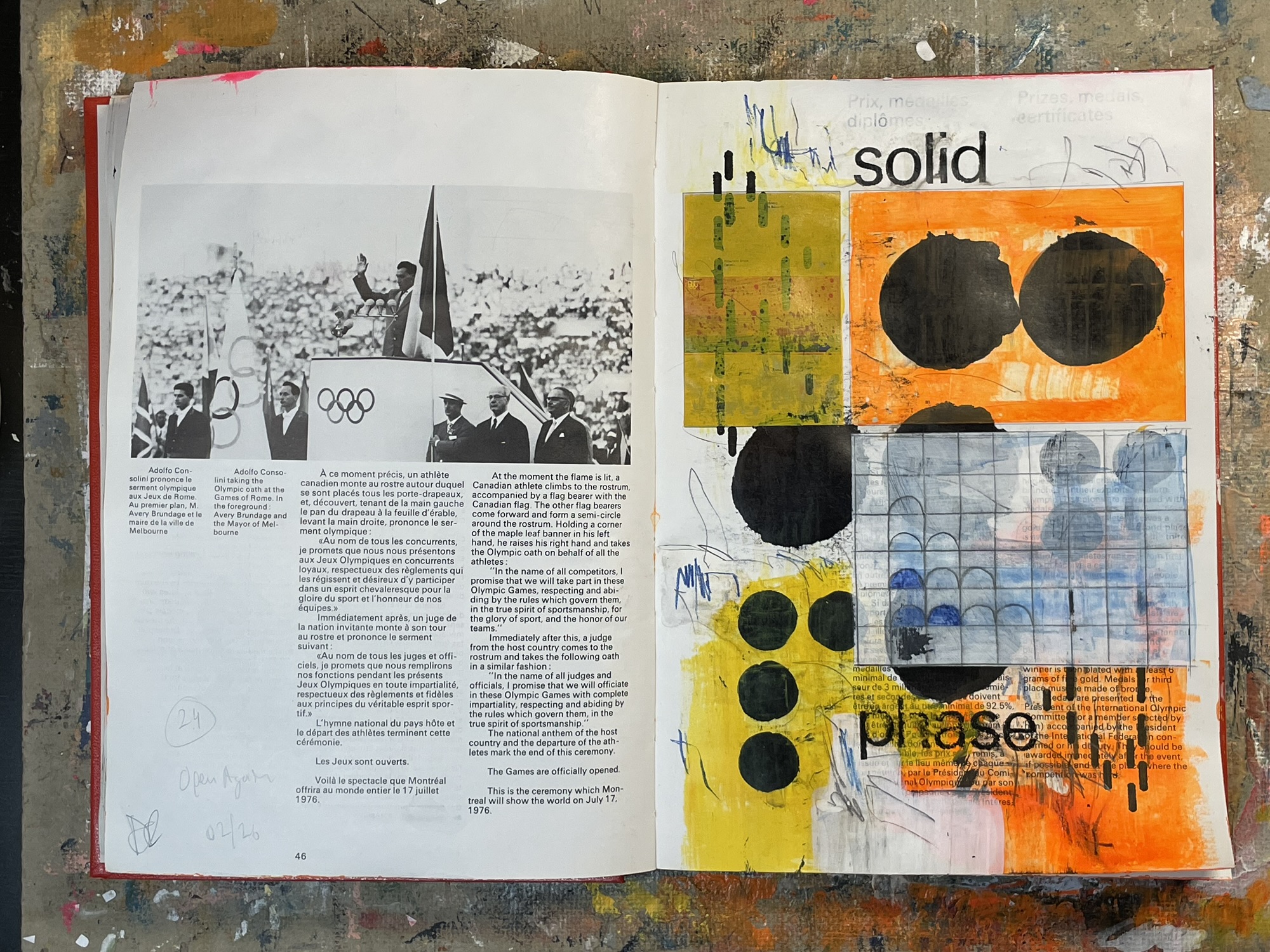
The art shown here is all made within the last few months and is part of my on-going Red Book project. The Red Book is a 1976 Olympics commemorative book that I am drawing in. I like the active surface of each page as something to react to.
Show Your Arms
I am not as interested in the literal process of “how” something is made that could be demonstrated in a tutorial of materials and techniques. Those can sometimes be informative and revealing, but I am more fascinated by the creative methods and approaches artists take. I want to know about the rhythms and personal systems that bring people to their easels and tables, move them through spaces with a camera, or place their hands on instruments to find their sounds.
I find in my work that tools and materials play roles but aren’t what gets me engaged. I need them in my hands to translate what’s in my head and heart onto the current surface but they are just a means to an end. They aren’t arbitrary since I choose media and tools based on properties I want but it’s still more about what happens during a drawing than what any of the component parts are.
There is No Record
So when it comes to other people’s work, I want to know the same sort of things.
Questions like…
What’s their relationship like with tools? Are they careful and specific or do they choose to make marks with whatever is close at hand?
Do they want a type of control over colour that means they frequently mix pigments or do they work straight from the tube?
Do they finish work in single sittings or do they come and go possibly over a long period of time?
Do they work on multiple pieces at the same time?
What are the processes that circle or connect to the process of making? Do they write to paint? Do they walk to sculpt?
Are there meta-creative structures or organization that allow people to get into a flow faster or deeper? The practice of keeping a maintained mise en place (a culinary term for “putting in place” or gathering tools and ingredients) can be crucial to some people and without it they feel adrift.
Open Again
Beyond the how, why people create is even more compelling. It’s also something that is harder for most people to place or articulate. They may simply say that creation is just a necessity, that they need to make to feel whole or sane or grounded.
For myself, those are all true and more. When I make there are a variety of connective and contradictory reasons why.
Physical presence in my body and an awareness of the motions I make as I make marks.
Physical disconnection from undue control I might be exerting over my body. Loosening and releasing.
Taking something mental that feels “stuck” and translating that into the action of drawing.
Communication of thoughts and feelings.
Connection with something inside myself.
Connection with something/one outside myself.
Transmute a hard or dark emotion into a safe and creative action.
Some artists wonder about their “purpose” or the meaning of what they make. I have found that while those questions aren’t without merit, they are also traps that for me lead to shut down.
The broader scope of how and why I make things is an active set of questions that interconnect and are less likely to have me turn on myself.
We Fade
Art can have purpose and meaning but both of those primarily happen after something has been made. And the shape the purpose and meaning are mostly in other people’s hands.
Truly
My friend asked…
“Are you generally happy with how most turn out or are there some clear winners and losers?”
I said…
“It’s a mixed bag. I definitely don’t love them all but I love that I made them. My primary goal is making with a secondary goal of enjoying myself. And then I like to share them even when I don’t like them since they might mean or feel something to somebody else. Trying not to engage in preciousness and self doubt.”
Celebration
Because this friend showed this kind of interest in my process, I also shared a link with them to one of the real time drawing videos I have posted to YouTube. It’s 52 minutes of me making one of the Red Book drawings start to finish. No edits or commentary. Just me making marks and choices.
I don’t post these videos often even though I shoot video of myself drawing most of the time for my own purposes. Most people’s appetite for watching art be made in real time is limited but I love it whenever I find someone just doing their thing and allowing an over the shoulder casual view.
Because the book that forms the container/surface for the Red Book drawings is a 1976 Olympics commemorative book, it’s not surprising that some of the existing photos and illustrations are sports related.
That aspect has nothing to do with why I chose this book to work in and in many contradictory ways I want to avoid those direct associations.
This particular page I’m currently working on had a colour diagram of a stadium layout. I enjoyed the pop of green as something to react to but didn’t want the sports stadium aspect to feel like it was a focal point. That may not really be up to me in the end of course so we’ll see when I finish this drawing how that aspect sits.
Before our neighbour’s very large Manitoba Maple tree fell on our garage I would take night sky photos with it in frame and had named it Ghost Tree. Since then this tall but much smaller and further away from our garage Cottonwood tree has become the New Ghost. It doesn’t have the same presence as the other tree but it still adds some drama to these shots.
On clear nights when our relatively countryside-adjacent property doesn’t have much light pollution — other than the same neighbours’ perpetual backyard security lights — I love star bathing. Moving out here from Toronto has had me marvelling at just how many stars I can see on many nights.
I ordered this gorgeous photo zine from Diana Pappas and Tom Bland and it came this week. The photos themselves are wonderful but the storytelling and the overall care in how they designed and packaged it really shines.
At a plaza here in town recently, I saw this scene from a distance in the fog and drove over to snap a few phone shots. This is a development site for new housing that used to be meadow and a pretty woods I hiked through a few times.
A deep swath of the woods was cut down and the meadow scraped down and this year it looks like there is further excavation to probably make way for utilities and such.
It’s an ugly eyesore and sure, people need homes but the way we treat the land to make that happen is pretty shocking.
But in the peculiar light of a foggy day, there is still a kind of beauty and mystery to be found.
In May 2007 I created an outdoor photo show in reaction to the large photography show Contact taking place in Toronto at the time.
Down the block from our apartment near Queen and Dufferin was a brownfield site with a tall chain link fence along the sidewalk.
I snuck in a back gate and made my way down a rough slope into the tangled brush behind the fence and arranged 36 photos I had printed at 2×3″ and mounted on popsicle sticks.
The size and the placement of the photos where less about people seeing my photos and more about people passing by and engaging with the non-space parts of the city that go unnoticed.
Those parts of the city were the subject of many of my photos from that time. The in-between and behind areas and the worn and broken elements. I was drawn to the suggested stories of things left behind but also simply to the beauty of texture and light in the city.
I watched in the weeks afterwards as the photos faded and fell off their sticks blowing away and mixing with the trash that always collected behind the fence.
I have posted a new video with a casual progress report about my Red Book project. I talk through the first 25 drawings and demonstrate how I react to the active surface of the pages as I draw.
All books are mechanisms for traversing time and space. These two books that I recently grabbed at the thrift store do that in multiple ways.
These Choose Your Own Adventure titles first came out in the lates 1970s and were just the thing for me as a pre-teen reader. I was reading the Narnia books and Madeleine L’Engle’s time warping novels. I also read loads of Ray Bradbury, Asimov, and harder science fiction like Larry Niven’s Ringworld books that mostly went over my head.
I was into computers and fantasy at the same time so there was something about stories that felt like smart adventures.
Foggy and melting at this beach today. As I arrived there was a couple in their full wedding clothes trudging through the slushy snow with three photographers including a drone pilot.
I guess they were trying to catch the magical feeling of the fog bubble today. The lake was essentially invisible, just a wall of hazy wall of white.
This is drawing number 24 in the Red Book, my current active surface drawing project.
Some of the last marks I added to this as I finished it this morning were two lists of five words. Lists of words have been common in my drawings over the last 10 years. I enjoy the somewhat random poetry they can evoke and also the visual shape of words and words in sequence.
Sometimes the words are pulled from a source text—like one of the 80+ year-old elementary school spelling books my partner and I collect—and other times they are just words that rise from my mind. Single words that suggest other words in turn, not to form sentences but to arrange in an associative matrix. You can see them just as words on their own or as a path to follow.
A physical artefact of an ephemeral time and place on the web. Joshua Davis’ Praystation Harddrive released roughly 25 years ago.
It was a time when the web meant exploration, discovery, and community to me. It was rough around the edges but if you looked you could see those edges and follow them.
The web now mostly feels like an infinitely sprawling grid of big box stores with the occasional service road and even more rare raw alleyway. The alleys are where the edges still exist, they are just much harder to access.
Let’s still make things. Digital and physical things that come from our heads, hearts, and hands. Let’s share what we make in public, in private, in secret. We can connect and find the edges together.
I think soon I will sit down at this table and spend more than two minutes making marks. But before then, it is good to still stand here for two minutes to draw grid lines and paste down paper towards something.
Marks and motion towards something are better than receding away from things.
Other than some work-related sketching, I hadn’t engaged in making anything visual since the beginning of January. My last time sitting at my work table was literally on January 1st.
There have been things that felt like barriers — most of them of my own creation. There has been grief and frustration with myself and a variety of external circumstances both mundane and cultural.
Art making comes from an emotional place for me and while it can be an “unblocker” it can also be one of the first things to become blocked.
Last night I spent two minutes doing this. Unblocking can start with one mark or take a hundred. We will see.