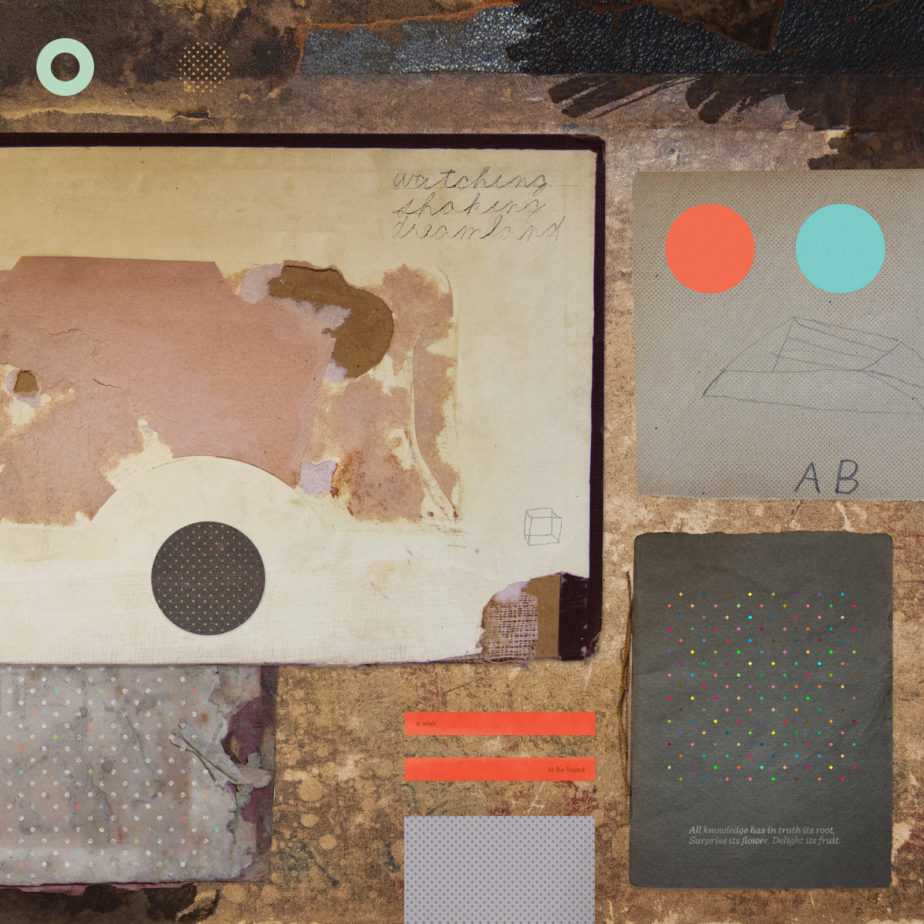
In 2015, I created a site called Amateur Escapist that I meant to function as a quarterly collaborative art zine based on my experiences with similar projects online in the early 2000’s. The first release First Words included nine artists (including myself) and I was blown away by the work submitted. For a variety of reasons, AE didn’t go beyond that first “issue” but I still have hopes of reviving it one of these days.
Assembled Dots and Feelings
Davin Risk for Amateur Escapist 01 : First Words, 2015, digital collage
A realization that I always move towards assemblage and the suggestion of a branching network of stories in simple elements. I am also recently taken with dots.
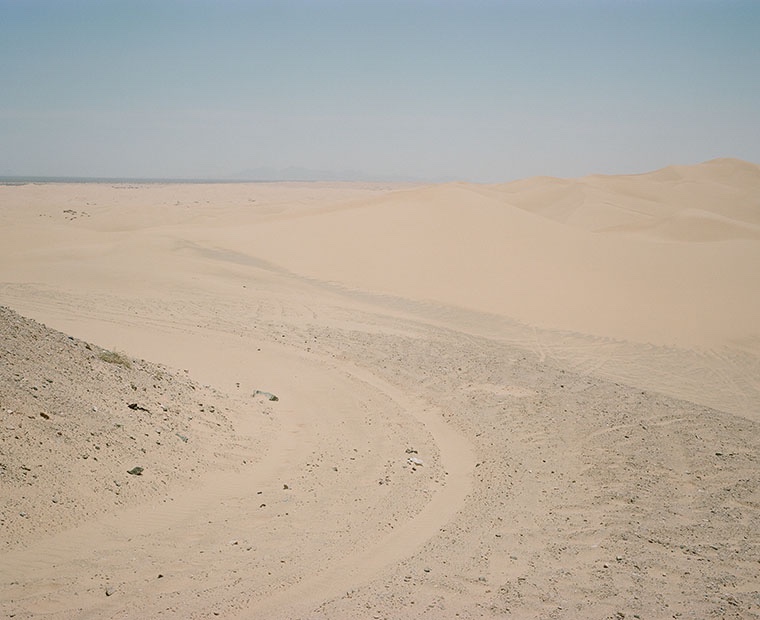
It’s mid–June in Eastern California. The Arizona and Mexico borders are equally close. With the daytime temperature locked at around 114°F, the obvious choice is to drive out into the middle of a wide expanse of rolling amber–coloured sand dunes.
This is our 20th anniversary trip*. We’re driving a semi-planned route through the deserts of California and Arizona. We have spoken about being in this landscape since shortly after we first met. Before we could even drive, we wanted to see this bizarre, harsh, and beautiful environment.
We haven’t been disappointed. Despite the incredible dry heat that pushes against you and even whips against you in oven hot wind, we are baffled, overjoyed, freaked out, and amazed by this place.
Travelling to the dunes on Route 78 East out of Brawley, California was an extra shock as green irrigated crop and grazing lands gave way to a wall of endless rolling sand.
In another season, this area is raucous with ATV traffic. The tracks criss–cross most surfaces and people come out here to day camp. The feeling as two odd Canadians here at a time when all the locals know better is both wonderful and a bit terrifying. Walking for a couple minutes across a few dunes and looking back, I can see only more dunes. The car and Gayla are no where to be seen so I head back.
The little cinder block campsite toilets off in the distance make me think of houses on Tatooine. My eternal inner Star Wars child is excited hoping to see a Jawa sandcrawler over the next rise. I will later find out that parts of Return of the Jedi were filmed here.
At points the dunes subside and flatten, stretching eventually towards dotted desert scrub lands. Still harsh and seemingly endless, the sparse silver-toned plants would be like a lush garden to someone emerging from these dunes after more than the couple of hours we stayed here.
Let’s travel down roads. We’ll find places and they will be ours for moments. Let’s get to where the land lays out in front and behind us — where there are places we’ve been and places still to see.
I have only been driving for a few years*. No teenaged backroads joyrides. No college road trips that weren’t at someone else’s whim. No coming of age cross country journey.
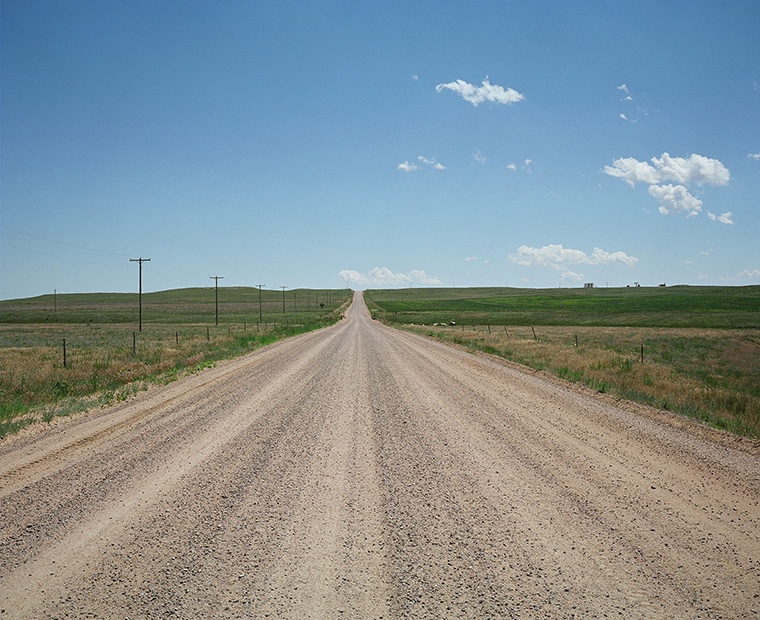
I still have the nervous habits and low endurance of a novice behind the wheel. Highways are white knuckle zones so we take the long way there. Wherever there is, we find the back roads, the service roads, the alleys, and the dirt tracks.
There is an unspecific promise that these roads have more stories to tell. Chance discoveries, mysteries, and hidden treasures are always down these roads. The leftover, forgotten, misplaced, and purposefully remote are never along the highway.
There is this feeling on some roads, which is linked forever with the opening scene of Gus Van Sant’s film My Own Private Idaho. The lonesome, somewhat desperate moments in which Mikey, played by River Phoenix, talks by himself into the quiet dawn air of a golden stretch of Idaho road.
I always know where I am by the way the road looks. Like I just know that I’ve been here before. I just know that I’ve been stuck here… like this one fucking time before, you know that? Yeah. There’s not another road anywhere that looks like this road. I mean, exactly like this road. It’s one kind of place. One of a kind. Like someone’s face. Like a fucked-up face.
It’s a feeling of impossible familiarity in the face of seemingly endless difference. The road stretchs out in either direction until its divergent ends dim giving no sense that they end.
Cars and driving I have no particular fondness for but they are the relatively easy means to finding places you might never find otherwise. Driving can be tedious and anxious but it condenses how big our world feels in a mostly controlled way. I’m glad, even if it sometimes still feels surreal, to have this late in life ability to choose a destination, a pace, and a route.
It was July 4th in Denver, Colorado and our kind friend Ross was playing tour guide and driver. Leaving the 92°F city streets behind us, he explained that we could literally drive to the top of a mountain. Denver, already the “mile-high city” at 5,280 feet looks out on a vista of peaks including 14,265 foot Mount Evans.
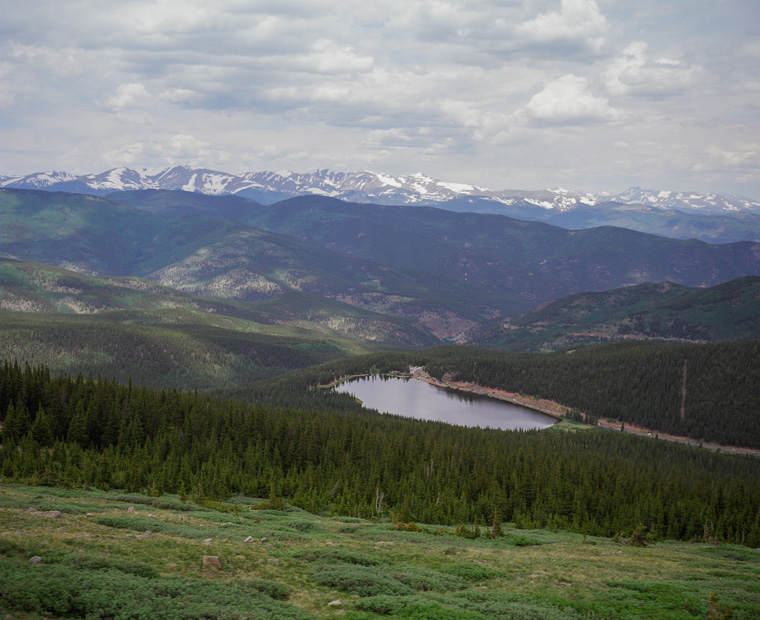
Apparently constructed in something of a tourism war between Denver and neighbouring Colorado Springs, the Mount Evans Scenic Byway is a grand American convenience — a smooth paved road that loops its way up to just a few feet below the mountain’s peak.
From visiting Denver’s Botanic Gardens we knew already that Mount Evans was home to some beautiful alpine plants and the bulk of the area’s Bristlecone Pines which are fascinatingly gnarled ancient trees.
We spent quite a while bending down to examine hundreds of plants which were tucked between boulders and holding fast to the dry sparse soil. The temperature had already significantly cooled from the throes of summer in the city. We marvelled at how easily our heads reeled and our breath got short with minimal exertion at the increased elevation.
It was the next shift that surprised us even more. The trees fell back in a clear line to reveal only a thin covering of scrub growth over tumbled boulders and the first glimpses of snowy drifts ran along ridges above us.
The dense forests left behind, the road lead to a plateau and a line of other visitors parked in a ribbon along the shoulder as we all left our cars to walk out and gape at Summit Lake, a shallow and glassy arc spilling out underneath thousand foot peaks.
Standing in t-shirts, arms wrapped around ourselves braced against the shock of 54° winds, was truly surreal. There are few places where you can experience such a rapid physical and environmental shift.
On our way back down from the mountain, well back into the Independence Day swelter, we were stopped dead in that finest American tradition, a traffic jam. We spent the next couple of hours dreaming of what we would eat and drink should we ever move from the blazing road — the chilled mountain lake nearly forgotten. When the cars finally moved again, we saw that we had been marooned on the highway by a flipped truck, its cargo of bright red apples swept to the edges of the road. Weary we shrugged and headed back towards the city.
^ Starlings used to nest in the eves of our old apartment.
The birds (along with a few squirrels and the near-feral neighbour cats) are keeping our backyard view alive. The vast majority of those birds have been Starlings.
The European Starling (Sturnus vulgaris) is widely derided as a pest bird — like weeds on the wing. They were introduced to the United States in 1890 by Eugene Schieffelin (a member of the American Acclimatization Society) as part of the poetic/naive gesture of bringing “the birds of Shakespeare” to Central Park. Starlings now number in the teeming millions from the hundred or so originally released.
Starlings have always been a fascination for me. The oil-slick iridescence of their feathers makes them a marvel to see up close but it is mostly their vast repertoire of appropriated bird songs that makes them so compelling.
You can often catch male Starlings perched high on rooftops or poles cycling through all the bird calls and environmental sounds they have committed to memory. If the “language of birds” is, as was once thought, the true original language, then Starlings are one of its great archivists.
Thinking about the adept mimicry of Starlings, I began to wonder about bird song in general. A bit of surface level reading (cough, Wikipedia) introduced me to the concept of song crystallization. Young birds are taught calls by mature tutors. They practice and elaborate on the calls as their social interaction increases going through a phase of plastic song until their song matures and becomes less varient. Amazingly, birds deprived of tutors and social interaction still sing but only in a limited simplified manner called isolate song — I feel sad just thinking about that. There I go, thinking about birds in human terms.
The fascination with bird song throughout the ages isn’t surprising. To us, its scope and complexity makes it easy to compare to the diversity of human language. The vast variety of bird calls from rasping to melodic communicate everything from alarm to sexual availability. People love to find something of themselves in the other animals around them and mysteries like the seemingly coded language of birds can take on mystical importance to some. The title of this post, Langue verte, refers to the belief that the language of birds was a “green language” — a pure form of language — even the language of angels.
I love watching the determined march of Starlings across grass — all bobbing their beaks into the ground repeatedly like those plastic drinking dippy birds.
As a large group of Starlings forage in our neighbour’s yard today, my attachment to them feels much more on their own level. I’ll certainly admit to my fair share of anthropomorphism when it comes to birds and other non-humans. But with Starlings I also feel excited simply to wonder at the complexity of their communication beyond any connection to human language or thought.
. . .
Update: Below I’ve added a video of some starlings in our current yard. We have quite large groups of them here to the point that they form micro-murmurations as they move in dark swathes between trees. This group is making some interesting water dripping sounds.
^ The wonder of childhood feels like this in my memory — rapid flashes with the occasional moment of brilliant clarity.
When we speak about childlike wonder we are drawing on a time when wonder was as innate as breath. For children, wonder is practically key to their survival. Wonder is synonymous with a child’s fluid acquisition of language and their drive to discover and define the seemingly infinite new things that get introduced to their senses. Our nacent sense of wonder is our earliest guide to the world.
It’s strange that we relegate wonder to the realm of childhood. To me, it feels just as innate and necessary to adult life — we adults are just unfortunately good at suppressing wonder. Because we tend to tag wonder as a child state, it becomes too susceptible to being derided as frivolous.
The intensity of needing to get close (and closer) to things to examine them in detail means we are often at a childlike distance from things that spark our curiosity.
Wonder deserves to be cultivated. A strong sense of adult wonder deepens our understanding and appreciation of everything around us. Wonder is amazingly not finite. I was thinking about wonder metaphorically as a choose-your-own-adventure system for discovery. Every observation, experience, and question are paths we take that always lead to further wonder if we let them. And the choices available often splay out before us iterating like fractal branches.
In a sense, wonder shared is culture. We bond to each other through mutual experience of our senses and our intellectual and aesthetic pursuits are formed almost wholly from our fascination with both describing and evoking wonder.
I felt compelled to write this as I can occasionally see the barriers I impose on my own strong sense of wonder. I sometimes need to remind myself that wonder is right there, as involuntary as breath to me, if I don’t hold it in.